Precision Marketing: What It Is and Why It Redefines Digital Marketing?
It's no secret to anyone: in today's digital ecosystem, investing in marketing without clearly justifying why each decision is made usually translates into wasted budget. It's not for lack of tools, but for lack of precision. Precision Marketing emerges precisely as a response to that problem—as a more conscious, strategic, and rigorous way of operating marketing in increasingly complex environments.
It's the logical evolution of digital marketing: an intelligent method that blends deep data analysis with advanced segmentation and personalization that actually works.
At Loymark, we define Precision Marketing as the ability to transform data into strategic decisions and, consequently, into tangible results. Our approach doesn't reside in the volume of campaigns, but in the superior quality of decisions made in pre-execution, execution, and post-execution. This distinction is what enables brands to transcend mere superficial impact and build sustainable growth.
Throughout this article, we explore what Precision Marketing really is, how it differs from the traditional approach, and, above all, how it can be intelligently applied to scale a business without depending on intuition or excessive investment.

What is Precision Marketing and why does it transform digital results?
Precision Marketing is a strategic methodology that uses data, advanced analytics, and technology to identify more clearly who to talk to, when to do it, and with what message. Unlike mass marketing, each action is supported by concrete insights about behavior, intent, and consumption patterns.
It's not just about segmenting better, but about understanding the complete context of each audience. To achieve this, this approach rests on some key pillars that work in an integrated way:
Real-time information that allows reading behaviors, interactions, and conversions as they happen.
Granular segmentation that goes beyond demographics and builds actionable microsegments.
Dynamic personalization that adapts messages and offers according to the moment in the customer journey.
Continuous optimization based on real performance, not assumptions or averages.
In markets like Latin America, where marketing budgets demand maximum efficiency, this approach becomes critical. The goal is no longer to reach more people, but to reach better those who truly have the highest probability of responding and generating value.
The real impact on businesses
When a company adopts a data-driven marketing approach, the impact translates directly to business results. Organizations that use insights about their customers' behavior to inform their decisions not only optimize their investment better but achieve greater effectiveness in every action. In fact, according to HG Insights (2025), companies that work with data-driven strategies are up to six times more likely to improve their profitability year over year, while increasing their conversion rates and reducing investment inefficiencies.
Data-driven personalization enables multiplying the return on marketing spend by five to eight times, boosting sales by more than 10%, and optimizing campaigns to achieve cost reductions close to 30%, while strengthening key metrics such as customer acquisition and retention.
More than a trend, Precision Marketing is the difference between campaigns that generate noise and strategies that generate sustainable growth
At Loymark, we've seen these results materialize when implementing Precision Marketing strategies for brands in Costa Rica and other Latin American markets, where the combination of predictive analysis and strategic execution allows transforming data into clearer decisions and, ultimately, into measurable results.

What differentiates Precision Marketing from traditional marketing
Traditional marketing usually relies on broad assumptions about large groups of people. It defines audiences based on general variables and communicates the same way to everyone, hoping that volume compensates for the lack of precision. Precision Marketing, on the other hand, starts from a different logic: working with certainties built from specific data for each segment.
This difference becomes evident from targeting. While the traditional approach is limited to basic criteria like age, gender, or location, Precision Marketing incorporates deeper variables such as user behavior, their intent, the context in which they interact, and their previous history. The result is not just finer segmentation, but a more real understanding of who you're talking to.
Traditional marketing operates with general assumptions; Precision Marketing works with data-based certainties
That logic also transforms the way messages are constructed. Instead of a single message designed for everyone, precision marketing allows adapting communication according to the user's profile and the exact moment they're at within their decision process. Relevance stops being an aspiration and becomes a direct consequence of analysis.
The difference continues in how measurement is done. Traditional marketing tends to focus on vanity metrics like impressions or reach, which describe visibility but not impact. Precision Marketing shifts attention to business metrics like customer lifetime value (LTV), customer acquisition cost (CAC), return on ad spend (ROAS), and incrementality, which allow understanding marketing's real contribution to growth.
The Data-Driven approach as a competitive difference
The true value of data-driven marketing isn't just in looking at the past, but in its ability to anticipate future behaviors based on historical patterns. While traditional marketing reacts to what already happened, Precision Marketing gets ahead of what's most likely to happen.
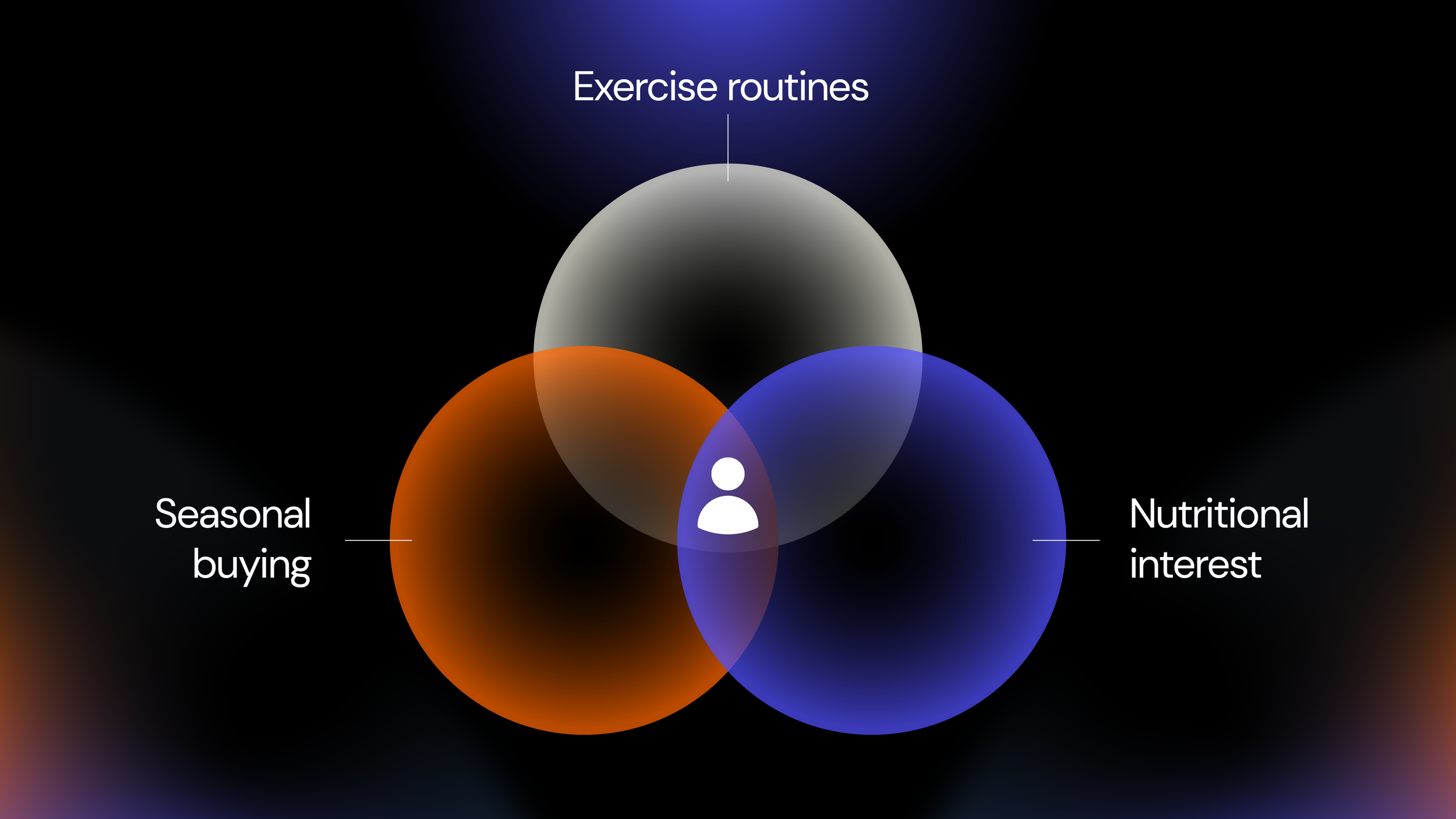
For example, instead of showing athletic shoe ads to a generic group like "men aged 25 to 35," Precision Marketing identifies users who have searched for exercise routines, visited sports nutrition content, show seasonal purchase patterns, and respond better to offers at specific times. This more granular reading allows each impression to have greater meaning and higher conversion probability.
This ability to read, predict, and adjust completely transforms campaign returns. At Loymark, we use predictive models and cohort analysis to build strategies that not only capture existing demand but anticipate and cultivate it in a sustained way.
Real benefits of precision marketing for your business
Adopting Precision Marketing goes far beyond optimizing specific campaigns. It implies a structural change in how a company makes decisions, allocates resources, and relates to its market. Various recent analyses on data-driven marketing strategies show that this approach converts marketing into a true growth engine, with direct impact on financial results and building lasting customer relationships (Digital Silk, 2026).
1. Optimization of advertising budget
One of the clearest benefits of Precision Marketing is its ability to reduce advertising waste. By basing decisions on real data about behavior, intent, and context, investment stops being a volume game and becomes an exercise in relevance. According to recent analyses, data-driven strategies allow optimizing campaigns and reducing costs by up to 30%, by redirecting budget toward audiences with higher conversion probability (Digital Silk, 2026).
This level of efficiency is especially critical for growing companies, where every dollar invested must demonstrate its real contribution to the business and long-term sustainability.
2. Improvement in customer experience
Precision Marketing responds to an increasingly clear market expectation: relevance. Consumers no longer react to generic messages; they expect interactions that reflect real understanding of their needs. The use of data allows designing personalized experiences in tone, timing, and format, generating greater emotional and functional impact.
In fact, 88% of marketers affirm that personalized experiences directly influence sales, which confirms that relevance is not just a perception factor but a concrete results trigger (Digital Silk, 2026). When messages feel timely and useful, the relationship strengthens and loyalty is built more naturally.
3. Data-based scalability
Unlike strategies guided mainly by intuition, precision marketing allows growing in a more predictable way. Data converts each campaign into a learning source that feeds the next one, refining audiences, messages, and investment allocation.
This approach favors continuous improvement cycles where performance is monitored in real-time and decisions are adjusted while campaigns are still active. It's no coincidence that 70% of marketers have increased their investment in performance marketing, seeking more transparent, measurable, and scalable models (Digital Silk, 2026). When each adjustment is supported by data, growth stops being random and becomes repeatable.
4. Sustainable competitive advantage
While many brands continue betting on mass reach, Precision Marketing prioritizes more precise and relevant connections. This ability to read the market with greater depth allows reacting faster, allocating resources better, and sustaining results over time.
Intelligent use of data also directly impacts retention: 90% of consumers are willing to interact with brands that offer personalized and incentivized experiences, which reinforces the value of building long-term relationships based on real customer knowledge (Digital Silk, 2026). This combination of efficiency, relevance, and loyalty constitutes a competitive advantage difficult to replicate without a solid foundation of data and analysis.
At Loymark, we've seen how companies that adopt this approach don't just improve isolated metrics. They transform their relationship with the market, moving from chasing customers to strategically attracting them through clearer, more precise, and sustainable decisions.
How to implement an effective data-driven strategy?
Implementing a data-driven marketing strategy is not a one-time exercise, but the construction of a living system. Precision Marketing only works when each step connects with the next and the strategy is constantly refined based on what's been learned.
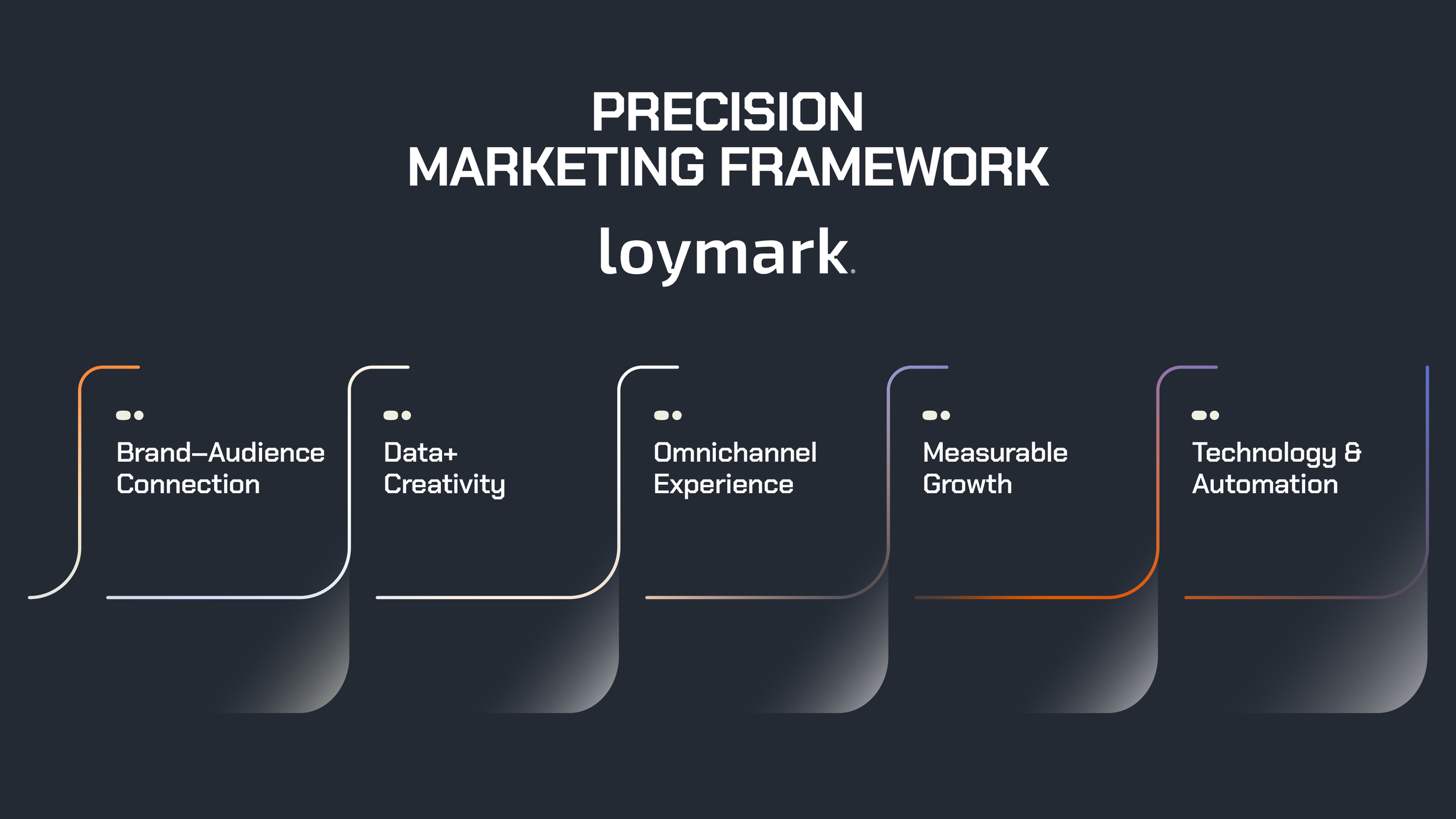
At Loymark, we don't conceive this process as a simple list of technical tasks, but through 5 fundamental principles that guide our execution:
1. Connect brands with people in more relevant ways
Relevance is no longer a differentiator; it's the foundation of modern relationships between brands and consumers. Brands that understand true human motivations and communicate with purpose gain attention, trust, and action.
How we achieve it: Precision begins by going beyond basic demographics. To implement this principle, we move toward advanced segmentation that includes behavior (specific actions), prediction (propensity models), and context (the exact moment of interaction). We stop talking to generic databases to connect with actionable audiences.
2. Transform data into better decisions and better creativity
Data identifies the opportunity, but creativity transforms it into impact. When insights and ideas work together, brands connect emotionally and scale meaningfully.
How we achieve it: We integrate a cycle of continuous testing and optimization. Through systematic A/B tests, incrementality analysis, and attribution model optimization, we ensure that data doesn't kill creativity but informs it. It's an iterative process where each campaign generates learnings to refine the visual and narrative message.
3. Drive measurable business growth... always the priority
Precision matters because it delivers results. Every strategy, investment, and execution is designed to move real business metrics, not just brand perception.
How we achieve it: A data-driven strategy only works when objectives are aligned with profitability. Beyond superficial metrics (like likes or impressions), we define and pursue real impact KPIs: Cost per Qualified Lead, Conversion Rate by segment, Customer Lifetime Value (LTV), and Return on Investment (ROAS). These indicators are our non-negotiable reference framework.
4. Create connected customer experiences
Customers don't see channels, they experience brands as a single journey. Fluid and connected experiences build trust, accelerate movement through the funnel, and unlock long-term value.
How we achieve it: We implement coherent multichannel personalization. We ensure that the narrative adapts but remains consistent at every touchpoint, whether through email marketing with dynamic content, personalized landing pages, or intelligent retargeting campaigns. The goal is to eliminate friction between the digital world and the purchase decision.
5. Scale personalization through technology
Technology is the engine that scales relevance. Through Artificial Intelligence and automation, brands deliver personalized experiences at speed, at scale, and in real-time.
How we achieve it: None of the above is possible without a solid foundation. We start with a data and technology audit to ensure that critical tools—such as Analytics, CRMs, conversion pixels, and automation platforms—are properly integrated. This infrastructure allows us to stop operating manually and start predicting and automating relevance for thousands of users simultaneously.
Common mistakes when adopting Precision Marketing: avoiding common pitfalls
Adopting Precision Marketing is a transformation process, not a simple addition of tools. While the benefits are clear, there are common barriers and mistakes that can sabotage the transition and limit the potential of the data-driven strategy. Recognizing these obstacles is the first step to ensuring that the investment in precision translates into expected growth.
Mistake 1: Starting without data infrastructure
One of the most frequent errors is attempting to implement Precision Marketing without having solid foundations for data collection and processing. When information isn't clean, integrated, and well-organized, any attempt at precision is diluted. Without adequate infrastructure, decisions continue to rely on assumptions and not on certainties.
Mistake 2: Obsession with technology over strategy
Tools are important, but they don't replace a clear strategy. The best software on the market doesn't compensate for poorly defined objectives or a fuzzy business vision. Precision Marketing works when technology accompanies a well-thought-out strategy, not when it tries to replace it.
Mistake 3: Ignoring privacy and compliance
In an environment marked by regulations like GDPR and constant changes in cookie usage, data-driven marketing must be ethical and transparent. Beyond legal compliance, user trust is a strategic asset that's built with responsible and clear practices.
Mistake 4: Expecting immediate results
Although data-driven marketing is powerful, it needs time to mature. Predictive models improve as they accumulate data and segmentation is refined with constant iteration. Precision is built progressively, not instantly.
Mistake 5: Implementing without a specialized partner
Precision Marketing is complex and requires a combination of skills that often don't reside internally. Attempting to develop and maintain a high-precision strategy without the guidance of a partner with experience in data infrastructure, technology, and strategic vision can lead to inefficiency, unexpected costs, and suboptimal results. Collaboration with experts accelerates the learning curve and guarantees optimization of tools and data.

Precision Marketing is not the future of digital marketing; it's the present for companies seeking to grow intelligently and sustainably. In a market where attention is limited and budgets must perform at their maximum, data-based precision marks the difference between simply spending and truly investing in marketing.
At Loymark, we combine technology, analysis, and strategy to implement precision marketing that generates measurable results. It's not simply about reaching more people, but about connecting with the right people, at the right time, and with the precise message.
Is your business ready to evolve toward a data-driven marketing approach? A strategic consultation with Loymark can be the first step to transform your advertising investment into predictable and scalable growth.
References:
HG Insights. (21 de marzo de 2025). Data-Driven Marketing: What it is & How To Build Your Strategy. https://hginsights.com/2025/03/21/data-driven-marketing/
Park, J. (2026). Data-Driven Marketing Strategy To Maximize ROI (2025 Guide). Digital Silk. Actualizado el 5 de enero de 2026. https://www.Digital Silk.com/digital-trends/data-driven-marketing-strategy/